Quick Answer
- Dubai offers 8% to 12% gross yields versus Melbourne’s 3.6%, with zero rental income tax.
- Dubai recorded AED 60.6 billion in Dubai property sales in February 2026 alone.
- Entry-level Dubai properties start from around AUD 250,000 to AUD 300,000.
- Buyers should budget for a 4% DLD fee and a 2% agency commission.
- Properties worth AED 2 million or more qualify for the 10-year UAE Golden Visa.
Melbourne investors have spent the last few years watching local yields flatten while entry prices stay stubbornly high, and it’s pushed more of them to weigh Dubai property investment as a genuine alternative rather than a novelty.
Dubai’s property market continues to outperform many established markets on rental returns and affordability. Flexible payment plans, freehold ownership, and long-term growth opportunities have made it an increasingly attractive option for Melbourne investors.
This guide compares what Melbourne actually delivers against what Dubai is offering right now, then walks through the areas, costs, buying process, and visa rules that matter most before you shortlist a project.
Melbourne Vs Dubai Yields

Yield is usually the number that starts this conversation, so it’s worth putting the two markets side by side before going any further. The gap between them is the reason so many Melbourne investors end up exploring options through events like the Dubai Property Expo Melbourne rather than continuing to search locally.
Melbourne Yield Data
Gross rental yields across Melbourne sit at approximately 3.6% as of early 2026, with dwelling values growing just 0.1% in January, and KPMG projecting house price growth of around 6.6% for the year overall, a picture the Dubai Property Expo Melbourne’s market comparison draws on when explaining why local investors are looking further afield. Once land tax, management fees, and maintenance are factored in, net yields in most Melbourne suburbs land closer to 3.2% to 4.5%, meaning many investors are barely breaking even once genuine holding costs are counted.
That combination of flat capital growth in the near term and thin net returns is precisely what’s driving Melbourne buyers to compare their numbers against markets that can offer a meaningfully different return profile.
Dubai Yield Data
Dubai’s rental market consistently delivers gross yields between 6% and 12%, with areas like Dubai Marina, Jumeirah Village Circle, and Business Bay attracting strong year-round tenant demand, and Property Finder’s Dubai listings data reinforcing the top end of that range with rental yields of 5.6% or higher across the broader market. Dubai also charges zero tax on rental income at source, though Australian investors must still declare that foreign income to the ATO.
For an investor deploying a similar amount of capital in both cities, the annual rental income from a Dubai apartment can run several multiples higher than a comparable Melbourne unit, which is the calculation most buyers are running before they even start looking at specific projects.
The yield gap is only part of the investment picture. Melbourne investors should also compare where that capital is being deployed and which Dubai communities offer the strongest combination of income and long-term growth.
Best Dubai Freehold Areas
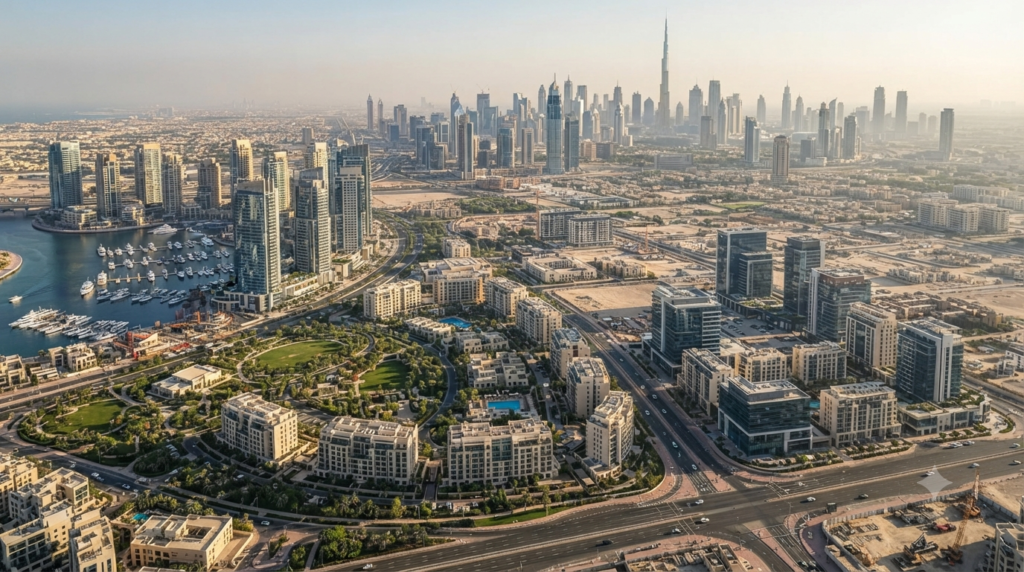
Once the yield comparison makes the case for looking further, the next decision is where in Dubai actually fits the budget and strategy. Foreign buyers can only own outright in Dubai’s designated freehold zones. Sobha Realty’s freehold areas count more than 50 of them across the city, and not all of them serve the same purpose.
Downtown & Marina
Downtown Dubai, home to the Burj Khalifa and Dubai Mall, commands premium pricing and delivers lower yields around 4–5%, but it makes up for that with the strongest capital appreciation and the deepest pool of high-net-worth tenants, a pattern the freehold area guide from RISE lays out clearly for foreign buyers weighing prestige against yield.
Dubai Marina sits close behind, offering waterfront apartments with strong, consistent tenant demand from professionals working across the city’s business districts. Buyers chasing long-term value storage and lifestyle appeal tend to gravitate here, while yield-focused investors usually look one tier down in price to the areas covered next.
JVC & Business Bay
Jumeirah Village Circle is frequently overlooked in favour of flashier addresses, but dubizzle’s residential listings data shows it consistently delivering some of the best yield-to-price ratios among Dubai’s freehold areas, drawing a large pool of young professional tenants into its studio and one-bedroom stock. Business Bay, immediately south of Downtown, has become one of the most active zones for new project launches along Sheikh Zayed Road, giving investors a central location without Downtown’s full price premium.
For most Melbourne buyers working with an AUD 300,000–450,000 budget, this pairing of JVC and Business Bay is usually where the numbers work hardest, balancing entry price against realistic rental demand.
Every freehold community offers a different balance of rental yield, capital growth, and entry price. Comparing these areas carefully helps Melbourne investors choose a location that aligns with both their budget and long-term investment goals
Property Prices And Costs

Price alone rarely tells the full story in Dubai, since the entry price and the total cost of ownership can differ meaningfully once fees are added; a point Dubai Property Finder’s UAE buying guide makes clear when it breaks down registration fees, agency commission, and mortgage costs separately from the sale price. Understanding both before comparing listings avoids an unpleasant surprise at settlement.
Entry Price Points
Dubai offers a wide range of entry points for Melbourne investors.
- Off-plan properties from leading developers typically start from AUD 250,000 to AUD 300,000.
- Many developers provide interest-free payment plans spread across the construction period.
- The Dubai Property Expo Melbourne event guide explains why these flexible payment plans attract first-time overseas buyers.
- Studio apartments in JVC and similar communities can start below AUD 250,000.
- Apartments in Dubai Marina and Business Bay generally start between AUD 350,000 and AUD 450,000.
Dubai’s competitive entry prices make overseas Dubai property investment more accessible for Melbourne buyers. Comparing these price points alongside rental yields helps investors identify the best long-term value.
Buying Fees Breakdown
Understanding the full purchase cost is just as important as comparing property prices.
- Property Finder’s UAE buying cost guide recommends budgeting for a 4% Dubai Land Department transfer fee.
- Agency commissions typically average around 2% of the purchase price.
- Owners of tenanted properties should also budget for the annual housing fee, generally 5% of the Dubai property’s average rental value.
- Off-plan purchases usually require a minimum 20% deposit, with remaining payments linked to construction milestones.
- Buyer funds are protected through RERA-regulated escrow accounts during the construction period.
Factoring these costs into your investment plan provides a more accurate picture of your total capital requirement. A clear understanding of purchase expenses helps Melbourne investors budget confidently and avoid unexpected costs.
Looking beyond the purchase price helps investors avoid unexpected expenses and make better financial decisions. A well-planned budget lays the foundation for a successful Dubai property investment.
How Melbourne Buyers Purchase

The mechanics of actually buying in Dubai from Melbourne are more straightforward than most first-time buyers expect, largely because, as the Dubai Property Expo Melbourne homepage explains to first-time attendees, the process is built to accommodate overseas investors who can’t easily fly over for every step.
Remote Buying Process
Many Melbourne investors complete their purchase entirely remotely through a Power of Attorney arrangement, though visiting Dubai beforehand for a personal inspection is generally recommended where practical. Driven Properties’ step-by-step buying process lays out the sequence clearly: identify the Dubai property, sign the Sale and Purchase Agreement, pay the deposit, and complete the title transfer at the Dubai Land Department, with the title deed issued in the buyer’s name on completion.
For ready properties, this transfer can be completed within two to six weeks once the paperwork is in order, while off-plan purchases move on the developer’s own construction and staged-payment timeline.
RERA Escrow Safety
Every off-plan transaction is required to run through a Dubai Land Department-managed escrow account, meaning a buyer’s funds are held securely and only released to the developer as construction milestones are actually met. Melbourne buyers attending the Dubai Property Show in Melbourne can verify a project’s RERA registration and escrow status directly with developer representatives before committing any funds, rather than relying solely on online listings.
That escrow protection is one of the clearest structural differences between buying in Dubai and buying in many other overseas markets, and it’s a big part of why the process has remained accessible to remote, first-time international buyers.
From remote purchasing to RERA escrow protection, Dubai provides a structured process for international investors. Careful planning and working with verified developers can help ensure a smooth and secure investment experience.
Golden Visa And Growth
Beyond the immediate numbers, two longer-term factors tend to shape whether a Melbourne buyer moves forward: residency eligibility and where the broader market is heading through the rest of 2026, both of which come up repeatedly in the Dubai Property Expo Melbourne’s own seminar sessions.
Visa Eligibility Rules
A completed, mortgage-free Dubai property worth AED 2 million or more — or one with at least 50% of any mortgage paid off — qualifies a foreign buyer for the UAE’s 10-year Golden Visa, with no local sponsor required and the ability to sponsor a spouse, children, and even domestic staff, according to Property Finder’s UAE visa thresholds. A lower-value purchase from AED 750,000 can also unlock a shorter-term investor visa, giving Melbourne buyers a staged pathway depending on their budget.
Because this visa sits outside the property investment decision itself, it’s worth treating as a separate, additional benefit to confirm with an immigration adviser rather than the primary reason to buy.
2026 Market Outlook
With Dubai recording AED 60.60 billion in Dubai property sales during February 2026 alone, as highlighted in the Dubai Property Expo Melbourne’s 2026 event, the market is showing record transaction volumes even as global conditions remain mixed, and forecasts point to tens of thousands of new residential units being delivered across 2025 and 2026 combined. For Melbourne investors comparing that momentum against a local market growing dwelling values by 0.1% in a single month, the relative pace of activity is hard to ignore.
None of this guarantees future performance, and Dubai’s market can move quickly in both directions, which is exactly why pairing the opportunity with proper due diligence, developer track record, RERA registration, and a realistic view of holding costs matters as much as the headline growth numbers themselves.
Evaluating visa eligibility alongside market fundamentals gives Melbourne investors a clearer picture of the opportunities ahead. With the right strategy and thorough due diligence, Dubai can become a valuable addition to a diversified property portfolio.
Is Property for Sale in Dubai Worth It for Melbourne Investors?
Property for sale in Dubai has become a genuine comparison point for Melbourne investors, not because Melbourne property has stopped working, but because the yield gap has become too wide to ignore. Gross returns of 8–12% against Melbourne’s 3.6%, paired with zero rental tax and a transparent, escrow-protected buying process, explain why more local investors are running the numbers on a Dubai purchase alongside their existing portfolio.
That said, the comparison only holds up when the full picture is considered: transfer fees, housing fees, currency exposure, and the practical realities of managing a tenanted Dubai property from the other side of the world all belong in the decision, not just the headline yield. Areas like JVC and Business Bay tend to suit yield-focused Melbourne investors best, while Downtown and Marina suit those prioritising long-term capital growth and prestige.
If you’re ready to move past the research stage and compare specific projects, prices, and payment plans face-to-face with licensed Dubai developers, register for the Dubai Property Expo Melbourne to book your private consultation.
Frequently Asked Questions
Can Melbourne residents buy Dubai property without visiting in person?
Yes. Many Melbourne investors complete their purchase remotely through a Power of Attorney arrangement, though a personal inspection before committing is generally recommended where practical. Digital contracts and international bank transfers make the process straightforward. Most developers and brokers also provide virtual tours and online document signing for overseas buyers.
How does Dubai’s rental yield compare to Melbourne’s in 2026?
Melbourne’s gross yield sits around 3.6%, with net returns closer to 3.2% to 4.5% after costs, while Dubai apartments typically deliver 8% to 12% gross yields with zero tax on that rental income. This difference can significantly improve long-term cash flow for investors. The final return still depends on the Dubai property type, location, and management costs.
What upfront fees should Melbourne buyers budget for in Dubai?
Beyond the purchase price, budget for a 4% Dubai Land Department transfer fee, a roughly 2% agency commission, and an annual housing fee equal to 5% of the property’s rental value if it’s tenanted. Off-plan purchases may also require a booking deposit and staged payments. Understanding these costs helps investors budget more accurately before purchasing.
Do I need AED 2 million to start with Dubai property investment?
No. Entry-level off-plan properties start from around AUD 250,000 to 300,000. The AED 2 million threshold only applies if you want the Dubai property to qualify for the 10-year Golden Visa. Many investors begin with lower-priced properties and expand their portfolio over time. Flexible developer payment plans also reduce the initial capital required.
Is my Dubai rental income taxed in Australia if I buy from Melbourne?
Dubai itself charges no rental income tax, but Australian investors must still declare foreign rental income to the ATO and report the Dubai property’s value in AUD each year. Eligible expenses such as management fees and maintenance may be deductible under Australian tax rules. Speaking with a qualified tax adviser can help ensure you remain compliant while maximising your investment returns.