Quick Answer:
- Dubai delivers 6% to 9% gross rental yields with zero UAE income tax on earnings
- Full freehold ownership rights confirmed for Australians in 60-plus designated zones
- Total purchase costs add 7% to 8% on top of property price including 4% DLD fee
- Off-plan risks include construction delays affecting 36% of projects in 2025
- Golden Visa residency from AED 750,000 with no minimum stay requirement for family
Melbourne investors searching for better returns in 2026 are landing on the same question. Is Dubai actually worth the complexity of buying overseas? The domestic market is not collapsing, but it is also not delivering. Melbourne gross rental yields sit at 3.5% before land tax and income tax at marginal rates. Net returns often fall below 2.5% for investors on higher ATO brackets. The numbers create a genuine problem that buying offshore starts to solve.
The honest answer to whether buying property in Dubai pros and cons tips toward a positive decision depends entirely on your investment goals, capital position, and time horizon. Dubai genuinely outperforms Melbourne on yield, tax structure, and entry pricing. It also carries real risks that are not always visible in developer marketing material. This guide gives Melbourne investors both sides of the equation without favouring either outcome.
This article covers every major advantage and disadvantage of buying property in Dubai pros and cons for Melbourne investors in 2026. You will find verified data on yields, costs, risks, legal protections, currency exposure, ATO obligations, and how to mitigate every downside identified.
The Pros: Why Melbourne Investors Buy Dubai Property

The case for buying property in Dubai for Melbourne investors rests on five structural advantages that the domestic market cannot replicate in 2026. Each advantage is quantifiable, verifiable, and consistent across established communities.
Zero Tax Environment
Australian investors in Dubai enjoy zero property tax, no capital gains tax, and no inheritance tax on Dubai properties. Buying a freehold apartment in Dubai does not trigger any ongoing municipal or council tax. Whether you flip an off-plan unit on handover or hold for ten years, the UAE currently imposes zero CGT on individuals.
For Melbourne investors on a 37% to 47% marginal tax rate, this structural difference transforms every return calculation. A 7% gross yield in Dubai delivers a 6% to 6.5% net yield after service charges and management fees. A 4% gross Melbourne yield often delivers below 2% net after land tax, income tax, and council rates.
Key tax advantages for Melbourne investors buying property in Dubai:
- Zero UAE income tax on residential rental earnings for individual investors
- Zero capital gains tax on Dubai property sales at any holding period
- No annual land tax in the UAE reducing returns year on year
- No inheritance tax on Dubai real estate assets
- ATO obligations managed through foreign income declaration only
The zero-tax structure is the single most impactful advantage in the buying property in Dubai pros and cons equation for Melbourne investors on higher marginal rates.
Superior Rental Yields
Dubai delivers rental yields that Melbourne cannot match at equivalent or lower entry prices. Rental yields in Dubai range from 6% to 9% across well-performing residential communities, with some emerging areas delivering above 10% for well-selected studio and one-bedroom apartments.
Melbourne vs Dubai rental yield comparison:
| Market | Gross Yield | Net Yield (after costs) | Entry Price |
| Melbourne inner ring | 3.5% | Below 2.5% | AUD 650,000+ |
| JVC Dubai | 6% to 8% | 5% to 7% | From AUD 210,000 |
| Business Bay Dubai | 7.07% | 5.5% to 6.5% | From AUD 420,000 |
| DAMAC Hills 2 | 7.69% | 6% to 7% | From AUD 252,000 |
| Dubai Marina | 6.62% | 5% to 6% | From AUD 378,000 |
On a AUD 420,000 investment, the difference between a 2.5% Melbourne net yield and a 6% Dubai net yield equals AUD 14,700 in additional annual income. Over ten years, that gap exceeds AUD 147,000 from a single comparable asset.
Accessible Entry Pricing
The minimum investment for a 2-year Investor Visa is AED 750,000. For the 10-year Golden Visa, the minimum property value required is AED 2 million. These thresholds were verified in March 2026 via official government sources.
Entry prices for buying property in Dubai sit dramatically below Melbourne equivalents. Studios in JVC and Dubai South start from AED 500,000, roughly AUD 210,000. Melbourne’s median apartment price exceeds AUD 600,000 with yields less than half Dubai’s performance.
Buying property in Dubai also unlocks UAE Golden Visa residency. A purchase at AED 750,000 grants a 2-year investor visa. AED 2 million unlocks the 10-year Golden Visa for the investor and full family. No Melbourne domestic purchase delivers a residency pathway alongside a financial return. As detailed in our guide on dubai golden visa property for Melbourne investors, this combination of investment and residency is unique globally.
The Cons: Real Risks Melbourne Investors Must Know
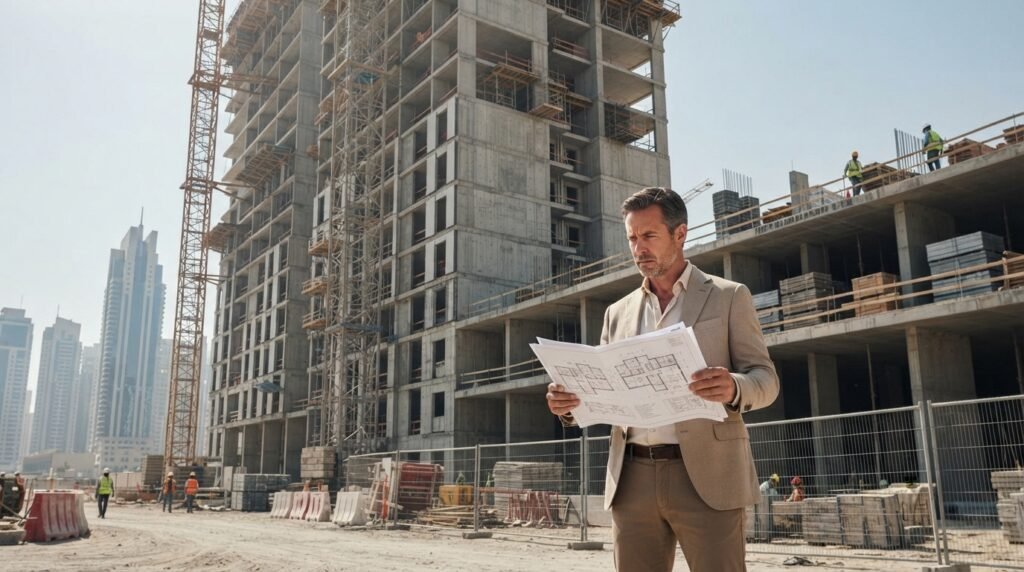
The disadvantages of buying property in Dubai are real, manageable, and frequently understated in developer marketing. Melbourne investors who understand each risk and plan mitigation strategies before committing capital consistently outperform those who discover them post-purchase.
Construction Delays
One of the most significant risks of buying property in Dubai is off-plan construction delays. Despite RERA oversight, only 64% of Dubai projects completed on time in 2025, the best rate in recent cycles. That means 36% of projects ran late by 12 to 24 months.
Construction delay risk mitigation checklist:
- Select developers with at least three completed and delivered projects
- Verify RERA registration and DLD-approved escrow account before paying any funds
- Review SPA penalty clauses for developer delay compensation before signing
- Build a 12-month income-free cash flow buffer into your payment plan model
- Focus on Emaar, DAMAC, Ellington, and Binghatti with verified delivery histories
Construction delay is the most cited con in the buying property in Dubai pros and cons conversation for Melbourne investors. It is also the most manageable with correct developer selection.
High Transaction Costs

Beyond the purchase price, Melbourne investors must consider the 4% Dubai Land Department fee, 2% agency commission, registration and administrative charges, and mortgage processing fees if applicable. Total transaction costs add 7% to 8% to the purchase price.
On a AUD 420,000 Dubai purchase, that means AUD 29,400 to AED 33,600 in one-time transaction costs before any rental income begins. Melbourne investors accustomed to stamp duty concessions or first home buyer schemes find this cost structure unfamiliar.
Full cost breakdown for buying property in Dubai from Melbourne:
| Cost Item | Amount | Notes |
| DLD transfer fee | 4% of purchase price | Mandatory, paid once |
| Agency commission | 2% plus 5% VAT | Zero on direct developer sales |
| DLD admin fee | AED 4,000 to AED 5,000 | Fixed government charge |
| Title deed issuance | AED 540 | Fixed fee |
| Oqood registration | AED 3,000 plus VAT | Off-plan purchases only |
| Mortgage registration | 0.25% of loan | UAE bank financing only |
| DEWA connection | AED 2,000 to AED 4,000 | Refundable deposit |
Transaction costs are fixed and non-negotiable. However, buying direct from developers at the Dubai Property Expo Melbourne eliminates the 2% agency commission, reducing total purchase costs by approximately AED 20,000 to AED 40,000 on typical Melbourne investor budgets.
Service Charge Impact on Yield
Annual service charges are a significant expense that directly impacts net ROI. They can range from AED 10 to over AED 80 per square foot per year in iconic buildings. For premium and waterfront projects with extensive amenities, this can be even higher.
Service charges are the hidden yield-killer most Melbourne investors discover only after purchase. A JVC apartment with 7.5% gross yield and AED 15 per square foot service charges may deliver 6.5% net. The same yield at AED 30 per square foot drops to below 5.5% net.
Service charge impact table for Melbourne investors:
| Building Type | Service Charge (per sqft) | Impact on 7% Gross Yield |
| Mid-market JVC | AED 10 to AED 15 | Net yield 6% to 6.5% |
| Business Bay standard | AED 15 to AED 20 | Net yield 5.5% to 6% |
| Dubai Marina premium | AED 20 to AED 30 | Net yield 5% to 5.5% |
| Downtown iconic | AED 40 to AED 80 | Net yield 4% to 5% |
Always request RERA-registered service charge schedules before comparing two projects on gross yield. A AED 5 per square foot difference annually shifts net yield by a full percentage point on a standard one-bedroom apartment.
Service charges are a genuine con in the buying property in Dubai pros and cons analysis. They do not eliminate the yield advantage over Melbourne but they must be modelled accurately before committing capital.
Currency and ATO Considerations

Currency exposure and Australian tax obligations are two of the most frequently misunderstood elements in the buying property in Dubai pros and cons analysis for Melbourne investors. Both are manageable. Neither should be ignored.
Currency Risk
The AED is pegged to the USD, so Australian investors are exposed to AUD/USD movements. A stronger AUD improves buying power, while a weaker AUD increases costs for deposits and repayments. Currency planning is essential, especially for off-plan purchases where payments continue across 2 to 4 years.
Currency risk management for Melbourne investors:
- Use OFX or Wise to lock exchange rates before large transfer amounts
- Schedule payment milestone transfers during periods of AUD strength where possible
- Model a 10% AUD weakening scenario across your full payment plan before committing
- Consider holding a portion of transferred funds in AED to buffer short-term rate movements
- Factor AUD/AED exchange rate into final net yield assumptions at handover
AUD/USD exchange rate movements affect the AUD cost of every subsequent payment milestone on an off-plan purchase. A 10% AUD weakening during construction adds meaningful cost to a payment plan denominated in AED.
ATO Obligations
While Dubai has zero local tax on rental income and capital gains, Australian tax residents must declare all worldwide income to the ATO. Dubai rental income must be reported under the foreign income section of your annual Australian return.
ATO obligations for Melbourne investors buying property in Dubai:
- Declare Dubai rental income under the foreign income section annually
- Claim deductions for management fees, depreciation, maintenance, and travel
- Report foreign assets exceeding AUD 50,000 to the ATO as a disclosure obligation
- Consult a registered Australian tax agent familiar with ATO foreign income rules before first return
- Apply for a Tax File Number declaration covering foreign income sources
This does not eliminate Dubai’s yield advantage. It moderates it. A Melbourne investor on a 37% marginal rate paying ATO tax on Dubai rental income still nets significantly more than the equivalent Melbourne property after Victorian land tax, income tax, and council rates.
From years of advising Melbourne investors on their ATO position, the most consistent mistake is assuming Dubai’s zero-tax environment means no Australian tax obligations. That assumption is incorrect and leads to avoidable compliance problems.
Who Should and Should Not Buy Dubai Property
The buying property in Dubai pros and cons analysis points clearly toward two distinct investor profiles. Understanding which profile matches your position prevents misaligned purchases.
Who Should Buy
For long-term investors with a 5-plus year horizon who perform thorough due diligence, Dubai remains a strong investment. Investors should focus on fundamentals: location, developer credibility, rental demand, realistic ROI, legal verification, and long-term exit potential.
Dubai property suits Melbourne investors who:
- Have a 5 to 7 year minimum investment horizon without requiring immediate full liquidity
- Can sustain payment instalments during construction without rental income for 2 to 3 years
- Are targeting income diversification away from AUD-only assets and Victorian land tax exposure
- Want residency through property investment at AED 750,000 or AED 2 million thresholds
- Have AUD 210,000 or more available including 7% to 8% transaction cost buffer
Melbourne investors who encounter the best outcomes from buying property in Dubai are patient, goal-clear, and research-driven before committing capital. Investors who encounter problems typically rushed the research phase under pressure from developer launch deadlines.
Who Should Not Buy
Short-term flippers and investors who need immediate maximum liquidity should approach Dubai carefully. Short-term flippers often struggle in this market due to high transaction costs and shifting demand. Long-term investors tend to see better results, provided they choose the right location and developer.
Dubai property is a poor fit for Melbourne investors who:
- Need full investment liquidity within 12 to 24 months of purchase
- Cannot sustain payment plan instalments without rental income during construction
- Have not modelled service charges, management fees, and ATO obligations on net yield
- Are selecting projects based on developer marketing without verifying RERA credentials
- Have less than AUD 240,000 available after including full transaction cost buffer
As covered in our comprehensive guide on Dubai property investment for Melbourne investors, the investors who consistently outperform are those who match community selection to investment objective before engaging any developer.
Ready to Invest from Melbourne?
Buying property in Dubai pros and cons analysis delivers a clear conclusion for the right Melbourne investor profile in 2026. Zero UAE tax on rental income, yields of 6% to 9%, entry from AUD 210,000, interest-free payment plans, and Golden Visa residency from AUD 315,000 create a return and lifestyle case Melbourne cannot currently match. The risks, including construction delays, transaction costs, service charges, and currency exposure, are all quantifiable, manageable, and mitigated through correct developer selection and pre-purchase planning.
Melbourne investors who enter the Dubai market with clear goals, verified developer credentials, accurate net yield models, and a 5 to 7 year hold horizon consistently deliver strong outcomes. The buying property in Dubai pros and cons equation tips firmly positive for that investor profile. It is a more complex decision than a domestic purchase, but the financial reward for executing it correctly is substantial.
Register today at dubaipropertyexpomelbourne.com.au to meet RERA-licensed developers from Emaar, DAMAC, Binghatti, Imtiaz, Ellington, and Omniyat and get expert guidance on navigating every pro and con of buying property in Dubai from Melbourne in 2026.
Frequently Asked Questions
Is buying property in Dubai a good investment for Melbourne investors in 2026?
Yes. Dubai offers 6% to 9% gross rental yields, zero UAE tax on rental income, and a lower entry price than Melbourne. Investors who choose quality developments and take a long-term approach are well positioned for strong returns.
What are the biggest cons of buying property in Dubai from Melbourne?
The main risks include construction delays, transaction costs, service charges, currency fluctuations, and Australian tax reporting obligations. These can be reduced through careful planning, developer research, and realistic financial modelling.
Do Melbourne investors pay tax on Dubai rental income?
Yes, but only in Australia. Dubai does not tax rental income or capital gains, while Australian tax residents must report overseas rental income to the ATO under standard tax rules.
What are the pros of buying property in Dubai compared to Melbourne?
Dubai offers higher rental yields, lower entry prices, zero UAE income and capital gains tax, and flexible developer payment plans. Eligible investors can also qualify for UAE residency through the Golden Visa programme.
Where should Melbourne investors buy property in Dubai to maximize returns?
Communities such as JVC, Business Bay, and DAMAC Hills 2 offer some of Dubai’s strongest rental yields and investment potential. The right location depends on whether your priority is rental income, capital growth, or long-term stability.