Melbourne investors are asking a harder question in 2026. Why keep stretching capital into a local market delivering 3% to 4% net yields when Dubai investment property offers double that return with zero rental tax? It is a question with a clear, data-backed answer.
Dubai closed 2025 with over 270,000 property transactions worth more than AED 917 billion, a 20% increase year on year. The market is not slowing down. It is maturing, and Melbourne buyers are paying attention.
This guide covers everything you need to know about Dubai investment property as a Melbourne-based buyer. You will find yield data, top communities, cost structures, tax obligations, financing options, and the fastest pathway to getting started without leaving Australia.
Why Dubai Investment Property Makes Sense for Melbourne Buyers in 2026

Melbourne has always attracted serious property investors. However, the local market in 2026 presents a familiar problem. Entry prices remain high, net yields remain thin, and Victoria’s land tax regime continues to compress returns for landlords holding multiple assets. Dubai investment property addresses each of those pressure points directly.
The case is not built on speculation. It is built on structural advantages that Melbourne investors can verify and measure before committing capital.
Tax Environment That Changes the Return Equation
The most immediate advantage of Dubai investment property for Melbourne buyers is the absence of local taxation. Dubai charges zero income tax on rental earnings. There is no capital gains tax on property sales. Annual council rates do not exist in the form Melbourne investors are accustomed to.
Gross rental yields averaging 6% to 7% are strong on their own. The fact that investors retain virtually all of that income is exceptional by global standards. For a Melbourne investor on a 37% marginal tax rate, a 7% gross yield in Dubai converts to a far stronger net outcome than a 5% gross yield in Melbourne after tax and land tax obligations.
Australian residents still declare Dubai rental income to the ATO. However, since Dubai charges no tax on that income, there is no double taxation. You pay Australian marginal rates on net Dubai income, but you keep far more of the gross than any comparable Australian investment delivers.
Market Driven by End-Users, Not Speculation
A concern Melbourne investors often raise about Dubai investment property is sustainability. Is the growth real? The 2025 to 2026 data addresses that directly.
What is particularly noteworthy for 2026 buyers is who is driving growth. End-users, people genuinely planning to live in Dubai, now represent a substantial share of purchases. That is a clear indicator of a market maturing, not one primed for a correction.
Property prices appreciated roughly 7% to 8% throughout 2025, with premium neighbourhoods like Palm Jumeirah and Downtown Dubai seeing even stronger gains. Apartments recorded 170,448 unit sales totalling AED 332.9 billion. Those figures reflect genuine demand from residents, professionals, and long-term investors, not short-term flippers.
AED-USD Peg Adds Currency Stability
Melbourne investors holding AUD-denominated assets face ongoing currency risk when markets shift. Dubai investment property introduces a useful counterbalance. The UAE dirham is pegged to the US dollar, a peg maintained without interruption since 1997. For Melbourne buyers diversifying out of AUD-only exposure, AED-denominated rental income provides a stable, dollar-linked income stream that is structurally independent of Australian market cycles.
For Australians, currency diversification matters. Holding an AED-linked asset can reduce concentration risk when all other assets and income are denominated in AUD.
Top Communities for Dubai Investment Property
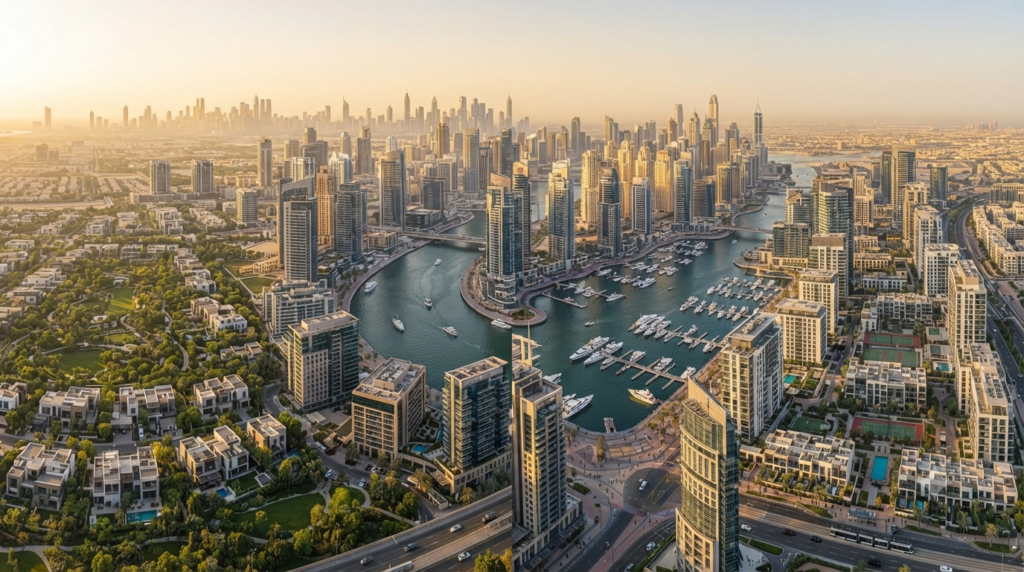
Community selection is the single most important decision in Dubai investment property. Different areas suit different goals.
Here are the four communities Melbourne buyers consistently focus on in 2026.
Highest Yield Entry Point
JVC is Dubai’s most transacted community and the strongest option for Melbourne investors targeting pure rental income. Rental yields in JVC can exceed 7% in 2026, making it one of the strongest growth corridors for yield-focused investors. Entry prices start from approximately AED 450,000 for one-bedroom apartments, roughly AUD 180,000 at current exchange rates.
Key features of JVC as a Dubai investment property location:
- Gross yields regularly above 7% for apartments
- Entry from approximately AUD 180,000 for one-bedroom units
- Over 350 residential buildings create deep resale liquidity
- Strong occupancy from young professionals and small families
- Interest-free off-plan payment plans available from multiple developers
Premium Returns for Short-Term Investors
Dubai Marina is among the most liquid and recognisable waterfront markets in the world. Its combination of tourism appeal, professional tenants, and metro access creates resilient rental demand year-round.
Key features of Dubai Marina as a Dubai investment property location:
- Strong short-term rental performance through Airbnb and Booking.com
- Year-round tourism demand creates resilient occupancy regardless of season
- Metro and tram connectivity attracts long-term professional tenants
- Limited waterfront land protects supply and supports long-term values
- Established resale market with strong international buyer interest
Balanced Yield and Capital Growth
Business Bay has evolved from a purely corporate district into one of Dubai’s most active mixed-use communities. Its proximity to Downtown Dubai and the DIFC makes it highly attractive to professionals and business owners as tenants.
Key features of Business Bay as a Dubai investment property location:
- Corporate tenant base drives stable, long-term lease agreements
- Canal-facing towers provide premium rents at below-Downtown pricing
- Consistently ranked in Dubai’s top five communities by transaction volume
- Active development pipeline from Binghatti, Omniyat, and Dar Global
- Strong infrastructure investment continues to lift long-term values
Family Stability and Long-Term Growth
Dubai Hills Estate is Emaar’s masterplanned community in the heart of New Dubai. It targets families, long-term residents, and lifestyle buyers who value space, greenery, and premium amenities. That demographic creates notably low vacancy rates and stable tenancies that often extend beyond three years.
Key features of Dubai Hills Estate as a Dubai investment property location:
- Family tenant profile creates long, stable lease agreements
- Golf courses, schools, and retail amenities sustain premium rents
- Emaar’s brand equity supports strong resale values over time
- Off-plan villas and apartments available across multiple price tiers
- Planned infrastructure upgrades continue through 2027 and beyond
The right community for a Melbourne investor depends on their income target, entry budget, preferred tenant profile, and investment horizon.
Cost of Dubai Investment Property

Return on investment calculations only mean something when all costs are accounted for. Melbourne investors must understand both one-time purchase costs and ongoing holding costs before committing to Dubai investment property.
Arriving at the expo with this knowledge allows you to ask precise questions and compare projects accurately.
One-Time Purchase Costs
Every Dubai investment property purchase involves several fixed costs at the point of transaction. None of these is a tax in the traditional sense. They are regulatory and administrative fees.
- Dubai Land Department registration fee: 4% of the purchase price. This is the highest one-time cost. It is paid once at registration and does not recur annually.
- DLD administrative fee: AED 2,000 to AED 4,000, depending on property value. A minor flat fee is added to the registration process.
- Agent commission: Typically 2% of the purchase price if buying through a registered broker. Developers at the Dubai Property Expo Melbourne do not charge commission to buyers.
- NOC fee: AED 500 to AED 5,000 depending on the developer. Required for resale transactions but not for off-plan purchases direct from developers.
- Mortgage registration fee: 0.25% of the loan amount if financing through a UAE bank. Not applicable for cash purchases or developer payment plans.
Ongoing Holding Costs
Dubai investment property involves recurring costs that affect net yield. Understanding these ensures your return projections are realistic from the outset.
- Annual service charges: Cover building maintenance, security, and community facilities. Charges vary by community and developer. Mid-market buildings in JVC typically charge AED 10 to AED 15 per square foot annually. Premium towers can reach AED 25 to AED 30.
- Property management fees: 5% to 8% of annual rental income for long-term management. 15% to 20% for short-term rental management.
- Utility connection fees: Electricity and water connection through DEWA involves a one-time AED 2,000 to AED 4,000 setup fee paid at handover.
- Contents insurance: Optional but recommended. Costs approximately AED 1,000 to AED 2,000 annually for a standard apartment.
What These Costs Mean for Net Yield
When considering net income from Dubai investment property, service charges typically represent 10% to 20% of gross rent. Higher service charges mean lower overall returns. Melbourne investors should always request service charge schedules from developers before comparing two projects on gross yield alone. A 7.5% gross yield project with AED 25 per square foot service charges may deliver lower net income than a 7% gross yield project with AED 12 per square foot charges.
Financing Options for Melbourne Buyers
Melbourne investors accessing Dubai investment property have several financing pathways available. Each suits a different capital position and investment strategy.
Developer Payment Plans: The Most Popular Option
The most common financing structure for Melbourne buyers is the developer payment plan. These are interest-free instalment arrangements tied to construction milestones. UAE GDP growth is estimated to have accelerated to 4.8% in 2025, with 5.0% projected for 2026. Against that backdrop, developer payment plans have become increasingly structured and competitive.
Typical plan structures include 60/40 (60% during construction, 40% at handover), 70/30, and post-handover arrangements where payments continue after the property is delivered. Some developers offer 1% per month plans after a 10% to 20% initial deposit.
These plans make Dubai investment property accessible to Melbourne buyers without heavy mortgage commitments or leveraging Australian home equity.
UAE Bank Mortgages for Non-Residents
Australians can use UAE banks to finance real estate purchases even as non-residents. Banks such as HSBC UAE, Mashreq, and Emirates NBD offer customised mortgage programmes. Starting fixed rates are around 3.99% to 4.44% for the initial fixed period, with variable rates linked to EIBOR typically ranging from 5.5% to 6.5%, depending on the loan-to-value ratio.
Non-resident borrowers typically access up to 50% loan-to-value on ready properties. Documentation requirements include proof of income, bank statements, and passport copies. Most Melbourne investors who choose mortgage financing use it to improve capital efficiency rather than out of necessity.
Australian Equity Release
Some Melbourne investors release equity from existing Australian property to fund Dubai investment property purchases. This approach uses familiar Australian banking structures while deploying capital into a higher-yield market. The key consideration is the ATO treatment of interest on funds borrowed for overseas property investment. Speak with your Australian tax advisor before proceeding.
ATO Obligations for Melbourne Investors
Owning a Dubai investment property as an Australian resident creates clear tax reporting obligations. Understanding them before purchase prevents complications at tax time.
What You Must Declare
Australian tax residents declare all worldwide income. Dubai rental income must be reported on your annual Australian tax return under the foreign income section. Relevant deductions include property management fees, maintenance costs, depreciation on furnishings and fixtures, and travel expenses for property inspection.
Australian Capital Gains Tax applies to profits from the sale of property in Dubai. The ATO treats foreign property the same as domestic investments. Since property income is not taxed in the UAE, you only pay in Australia, but accurate reporting requires thorough documentation.
What You Can Deduct
The absence of Dubai-side taxation does not mean no deductions are available to Melbourne investors. Australian tax rules allow deductions on expenses directly related to earning rental income from overseas property. Consult a registered Australian tax agent familiar with UAE real estate before your first tax return after purchase.
Foreign Asset Reporting Threshold
Australian taxpayers must report foreign assets worth more than AUD 50,000. Most Dubai investment property purchases exceed this threshold, meaning disclosure is required from the first year of ownership. This is a reporting obligation, not a tax trigger. It simply ensures the ATO is aware of your international asset base.
How to Get Started with Dubai Investment Property from Melbourne

Melbourne investors have a clear, practical pathway to their first Dubai investment property. Most steps can be completed from Australia without travelling to the UAE.
Step 1: Attend the Dubai Property Expo Melbourne
The fastest way to compare projects, meet developers, and understand your options is at the Dubai Property Expo Melbourne. Licensed developers from Emaar, DAMAC, Binghatti, Imtiaz, Ellington, and Omniyat exhibit 100-plus projects with live pricing, yield data, and payment plan structures.
One-on-one consultations allow Melbourne buyers to discuss specific budgets and goals with developer representatives and investment advisors in the same afternoon.
Step 2: Confirm Your Legal Ownership Rights
As explained in our guide on buying property in Dubai, Australians have full freehold ownership rights in over 60 designated zones. No local partner is needed. No UAE residency is required before purchase. The process is straightforward and well-governed by RERA and the Dubai Land Department.
Step 3: Know What the Dubai Property Show Covers
The Dubai Property Show Melbourne includes sessions specifically covering cost structures, ATO implications, and Golden Visa eligibility. Arriving with your budget and investment goals defined allows you to make the most of every conversation at the event.
Frequently Asked Questions
What is the minimum budget for a Dubai investment property for Melbourne buyers?
Off-plan apartments in high-yield communities like JVC start from approximately AED 450,000, roughly AUD 180,000. With a 10% deposit requirement, Melbourne buyers can enter the market for as little as AUD 18,000 upfront on a developer payment plan. Golden Visa eligibility starts at AED 2 million, approximately AUD 800,000.
Is Dubai investment property safe for first-time overseas buyers?
Yes. RERA governs all developers and agents. Buyer funds go into DLD-supervised escrow accounts and are only released to developers against verified construction milestones. Every developer at the Dubai Property Expo Melbourne holds a valid RERA licence. The regulatory framework protects Melbourne buyers at every stage of the transaction.
How long does it take to complete a Dubai investment property purchase?
Off-plan purchases can be reserved within days. The full legal process, including Sales and Purchase Agreement signing, DLD registration, and title deed issuance, typically completes within two to four weeks. Most Melbourne buyers complete this process remotely through power of attorney arrangements.
Do Melbourne investors need to visit Dubai to buy investment property?
Not necessarily. Australians can invest in Dubai real estate remotely without visiting, provided they follow the correct process and use the right documents. Power of attorney arrangements and digital DLD registration support fully remote purchases. A visit before handover for personal inspection is recommended but not required.
What happens to my Dubai investment property if I want to sell?
You can sell freely on the secondary market at any time. There is no capital gains tax in Dubai. The buyer pays the 4% DLD transfer fee. Resale transactions in high-demand communities like JVC, Business Bay, and Dubai Marina typically complete within 30 days through a RERA-licensed broker.
Take Your Next Step Into Dubai Investment Property from Melbourne
Dubai investment property delivers what Melbourne’s 2026 market cannot match. Tax-free yields of 6% to 8%, accessible entry from AUD 180,000, currency-stable AED-linked income, and a regulatory framework that protects overseas buyers at every stage. The market is maturing on the back of genuine end-user demand, and the pathway from Melbourne to ownership has never been more straightforward.
The Dubai Property Expo Melbourne 2026 brings verified developers, live market data, and expert guidance directly to your city. Compare 100-plus curated projects from Emaar, DAMAC, Binghatti, Imtiaz, Ellington, and Omniyat in a single afternoon.
Register today at dubaipropertyexpomelbourne.com.au and take your first step toward a high-performing Dubai investment property portfolio in 2026.