Melbourne investors are searching harder than ever for returns that make sense in 2026. Local gross yields have flatlined at around 3.6%. Victorian land tax continues to erode net income. And rising Melbourne entry prices stretch capital further without delivering proportional returns. Against that backdrop, Dubai rental properties are drawing serious attention from experienced Melbourne buyers who want their capital working harder.
Dubai rental properties consistently deliver gross yields of 6% to 8% in established communities. Some areas push well beyond that. The tax-free environment means most of that gross income stays intact as net return.
This guide breaks down the yield data, the top communities, the key differences between short-term and long-term strategies, and exactly how Melbourne investors can access Dubai rental properties in 2026 without flying to the UAE.
Why Dubai Rental Properties Outperform Melbourne

The yield gap between Dubai and Melbourne has become one of the most discussed topics among Australian property investors. It is not a marketing claim. It is a measurable, data-backed difference that compounds significantly over time.
Three structural forces drive Dubai’s rental performance above global peers.
Tax-Free Advantage Is Real and Significant
Dubai charges zero income tax on rental earnings. There is no capital gains tax either. For Melbourne investors accustomed to paying marginal tax rates of up to 47% on investment income, this difference is dramatic.
As of late 2025, the average rental yield for new contracts in Dubai stood at 7.07%, while renewal contracts averaged 6.76%. For a Melbourne investor assessing a fresh purchase, that 7.07% gross figure stays close to the net figure after costs. Compare that with a Melbourne investment property yielding 4% gross before land tax, income tax, and council rates. The effective net return in Melbourne often falls below 2.5% for investors on higher marginal rates.
Population Growth Sustains Tenant Demand
Dubai’s population continues to grow at a pace few global cities can match. Professionals, entrepreneurs, and families relocate to the UAE consistently, driven by visa reforms, business opportunities, and lifestyle appeal. The steady influx of expatriates and professionals ensures consistent rental income for property owners, strengthening Dubai’s position as a top investment destination.
That sustained demand keeps vacancy rates low across top communities. It also creates upward pressure on rents year over year. For Melbourne investors holding Dubai rental properties over a five to ten-year horizon, both income and capital growth work in their favor.
Dubai’s Rental Market Is Regulated and Transparent
A common concern among first-time overseas investors is whether rental income is reliable and enforceable. Dubai’s rental framework is among the most structured in the region. RERA governs all tenancy contracts. The Rental Dispute Center provides a formal resolution mechanism. Rent increase limits protect both tenants and investors from arbitrary swings.
Dubai rental yields currently range between 6% and 8% in well-performing residential areas, with some emerging communities offering higher yields. That range reflects a market with real regulatory depth, not speculative noise.
Top Communities for Dubai Rental Properties
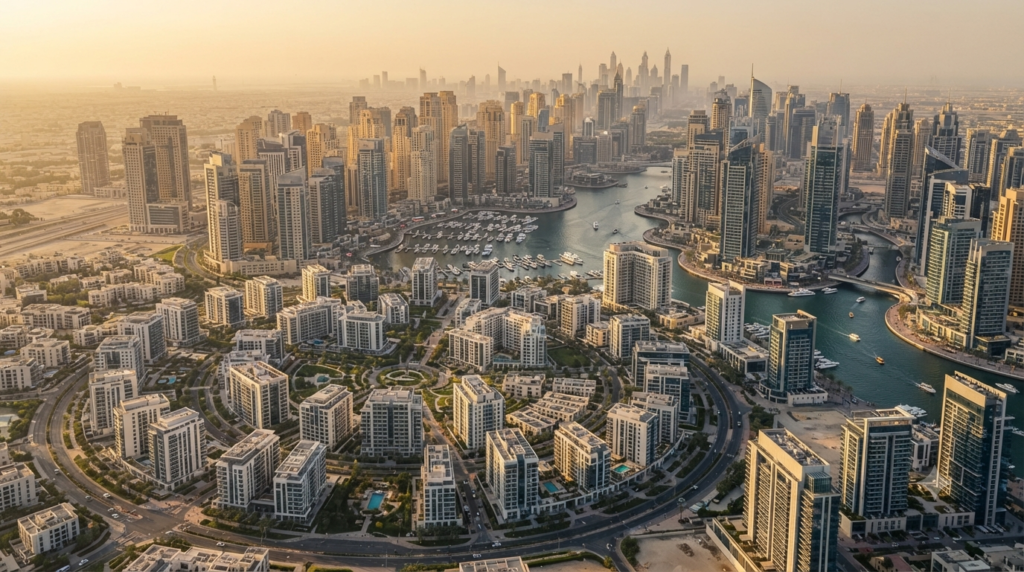
Not all Dubai rental properties perform equally. Community selection is the single biggest driver of yield outcomes. Melbourne investors should evaluate each area against their income goal, entry budget, and preferred tenant profile.
Here is a breakdown of the top-performing communities for rental income in 2026.
Jumeirah Village Circle: Highest Yield for Accessible Entry
JVC is the most traded community in Dubai and the strongest performer for yield-focused investors. JVC offers the best rental yields in prominent city center areas for three-bedroom apartments, with an average of 7.21% in 2026. Al Furjan delivers even higher yields for studio apartments, averaging 8.51%.
Key characteristics of JVC for Melbourne investors:
- Over 350 residential buildings are creating a deep, liquid secondary market
- Diverse tenant base of young professionals, couples, and small families
- Strong occupancy rates driven by central location and community amenities
- Multiple off-plan launches annually from developers, including Binghatti, Imtiaz, and Ellington
- Interest-free payment plans are regularly available from an AED 450,000 entry
Entry prices in JVC start from approximately AED 450,000 for one-bedroom apartments. That translates to roughly AUD 180,000 at current exchange rates. For Melbourne investors comparing that with AUD 650,000-plus for an inner-ring Melbourne unit yielding 3.5%, the case for Dubai rental properties in JVC is compelling.
Dubai Marina: Premium Yields Through Short-Term Rentals
Dubai Marina is among the most internationally recognized waterfront communities in the world. Its year-round tourist appeal and professional tenant base create consistent rental demand across both long-term leases and short-term rental platforms.
Key characteristics of Dubai Marina for Melbourne investors:
- Strong short-term rental performance through platforms like Airbnb and Booking.com
- Year-round tourist and professional demand create resilient occupancy
- Metro and tram connectivity attract long-term tenants who prefer car-free living
- Waterfront scarcity limits new supply and protects long-term values
- Entry prices from approximately AED 900,000 for one-bedroom apartments in established towers
Dubai continues to offer some of the highest rental yields in the world, typically ranging from 5% to 12% depending on location and property type. Dubai Marina sits toward the upper end of that range for well-managed short-term rental units.
Business Bay: Balanced Yield and Capital Preservation
Business Bay combines a prime central address with yields that remain competitive without requiring entry at Dubai Marina price levels. It sits directly adjacent to Downtown Dubai and the Burj Khalifa, drawing corporate professionals and business owners as tenants.
Key characteristics of Business Bay for Melbourne investors:
- Corporate tenant base creates stable, long-term lease agreements
- Canal-facing towers command premium rents at below Downtown entry prices
- Consistently ranked among Dubai’s top five communities by transaction volume
- Active pipeline of new branded residences from Binghatti and Omniyat
- Strong resale liquidity for investors with a five to seven-year exit horizon
Dubai offers an average ROI between 6% and 10%, depending on location, property type, and rental demand. Areas like JVC, Dubai South, and Arjan offer some of the highest rental yields in 2026.
Short-Term vs Long-Term Dubai Rental Properties
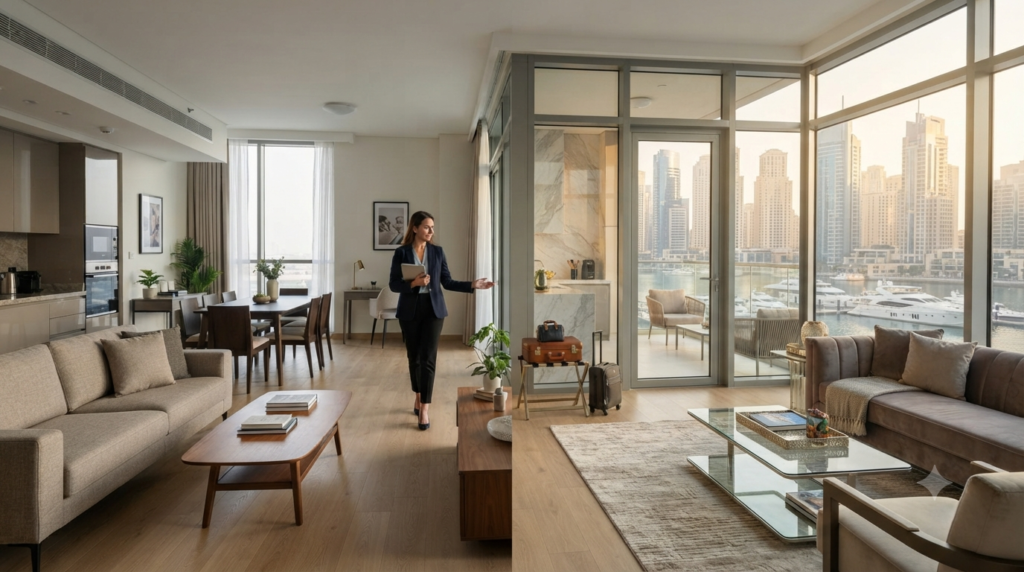
One of the most important strategic decisions for Melbourne buyers entering Dubai rental properties is the rental model. Both approaches work. The right choice depends on your income goals, tolerance for involvement, and chosen community.
The distinction matters more in Dubai than in most markets because the gap between short-term and long-term yields can be significant in high-tourism areas.
Long-Term Rental Strategy: Stable, Passive, Predictable
Long-term leasing in Dubai typically involves annual or two-year contracts. The tenant pays rent in advance via post-dated cheques, which is standard practice. This structure provides Melbourne investors with predictable, upfront income that requires minimal ongoing involvement.
Most investors can expect rental yields between 6% and 8% in established communities through long-term rental strategies. Management fees for long-term rentals typically range from 5% to 8% of annual rental income. After management fees and service charges, net yields for long-term Dubai rental properties sit between 5% and 7% in most top communities.
Short-Term Rental Strategy: Higher Gross, More Active Management
Short-term rentals through platforms like Airbnb deliver higher gross income in tourism-heavy communities. Dubai Marina, Downtown Dubai, and Palm Jumeirah see strong tourist occupancy year-round. Short-term operators can achieve gross yields above 10% in well-located units.
However, the management overhead is real. While holiday homes can offer 20% higher gross revenue, management fees of 15% to 20%, and utility bills paid by the landlord mean the net ROI is often similar to long-term leasing, just with more effort.
Hybrid Approach: The Best of Both Models
Some Melbourne investors split their Dubai portfolio between a long-term rental unit in JVC for stable passive income and a short-term rental unit in Dubai Marina for higher gross returns. This combination balances predictability with income upside. Both assets benefit from Dubai’s zero-tax rental environment.
For Melbourne investors managing from Australia, professional short-term rental management firms absorb the operational load. Fees are higher, but the model remains viable for the right community and unit type.
Understanding Net Yield on Dubai Rental Properties

Gross yield figures are useful for comparison. However, Melbourne investors should always underwrite Dubai rental properties on a net basis before committing capital.
Key Costs That Reduce Gross Yield
Several recurring costs affect the net yield on Dubai rental properties. Understanding each one upfront protects your return assumptions.
- Annual service charges: These cover building maintenance, security, and community amenities. Charges vary by developer and building quality. Premium towers in Downtown Dubai can charge AED 25 to AED 30 per square foot annually. Mid-market buildings in JVC typically charge AED 10 to AED 15 per square foot.
- Property management fees: Standard long-term management costs 5% to 8% of annual rent. Short-term management runs 15% to 20%.
- Vacancy allowance: Build a 5% annual vacancy buffer into your yield calculation. Well-managed units in high-demand communities often beat this assumption, but it keeps projections conservative.
- Maintenance and minor repairs: Budget approximately 1% of property value annually for ongoing maintenance.
Net yield accounts for all holding costs beyond the purchase price. Getting this calculation right prevents surprises after settlement.
A Realistic Net Yield Calculation
Using a real example: an AED 900,000 apartment generating AED 75,000 in annual rent, minus AED 12,000 in service charges, maintenance, and a 5% vacancy allowance, delivers a net ROI of approximately 7.4%. That is a strong return by any global benchmark. In Melbourne, achieving 3% net on a comparable investment would be considered solid.
What a Good Net Yield Looks Like in 2026
In 2026, a 5% to 6% net yield on Dubai rental properties is considered stable and low risk. A 6% to 8% net yield is strong and well-structured. An 8% to 10% or higher net yield is high-performing and typically area and asset-dependent.
Melbourne investors targeting income over growth should aim for JVC or Business Bay. Those targeting growth alongside income should consider Dubai Hills Estate or Dubai Creek Harbor, where appreciation potential supplements moderate yields.
How Melbourne Investors Access Dubai Rental Properties
The practical pathway to owning Dubai rental properties from Melbourne is more straightforward than most investors expect. Most steps can be completed remotely.
Step 1: Research and Compare Communities at the Expo
The fastest way to compare Dubai rental properties side by side is at the Dubai Property Expo Melbourne. Licensed developers from Emaar, DAMAC, Binghatti, Imtiaz, Ellington, and Omniyat exhibit their current projects with live yield data, payment plan structures, and floor plans.
Unlike online research, the expo gives Melbourne investors direct access to developer representatives who can answer specific yield and management questions on the spot.
Step 2: Confirm the Buying Process and Legal Structure
As detailed in our guide on buying property in Dubai, Australians have full freehold ownership rights in over 60 designated zones. The purchase process involves a Sales and Purchase Agreement, a 10% to 20% deposit into a RERA-supervised escrow account, and a one-time 4% Dubai Land Department registration fee.
Most Melbourne investors complete these steps remotely through power of attorney arrangements.
Step 3: Appoint a Property Manager Before Settlement
Appointing a licensed Dubai property management firm before settlement ensures your rental campaign starts immediately after handover. A good manager handles tenant screening, contract execution, rent collection, and maintenance coordination. For Melbourne investors holding Dubai rental properties from Australia, professional management makes ownership genuinely passive.
Frequently Asked Questions
What rental yield can Melbourne investors realistically expect from Dubai rental properties?
In established communities, gross yields of 6% to 8% are standard. After service charges, management fees, and a vacancy allowance, net yields typically land between 5% and 7%. High-performing communities like JVC can push net yields above 7% for well-selected, professionally managed units.
Are Dubai rental properties taxed for Australian residents?
Dubai charges no income tax on rental earnings. However, Australian residents must declare all worldwide income to the ATO, including Dubai rental income. You can claim deductions for management fees, maintenance, and depreciation. Speak with a registered Australian tax agent to structure your reporting correctly.
Can Melbourne investors manage Dubai rental properties remotely?
Yes. Professional property management firms in Dubai handle all day-to-day operations. Fees range from 5% to 8% for long-term rentals. This structure makes Dubai rental properties genuinely passive for Melbourne-based owners. Most investors visit Dubai for an initial inspection and then manage the ongoing remotely.
What is the minimum investment to access Dubai rental properties?
Off-plan apartments in high-yield communities like JVC start from approximately AED 450,000, roughly AUD 180,000. Interest-free developer payment plans spread costs across two to four years. Ready properties generating immediate rental income typically start from AED 700,000 to AED 900,000, depending on the community.
What is the Dubai Property Show Melbourne, and how does it help rental property investors?
The Dubai Property Show Melbourne is a live exhibition where licensed developers present current rental investment projects from Dubai. Melbourne investors can compare yields, payment plans, and communities side by side in one afternoon. Many investors reserve units at expo-exclusive pricing on the day.
Start Exploring Dubai Rental Properties from Melbourne
Dubai rental properties deliver what Melbourne’s market currently cannot: tax-free yields of 6% to 8%, accessible entry from AUD 180,000, and a growing tenant base driven by sustained population growth. The fundamentals are strong, the regulatory framework is transparent, and the pathway from Melbourne to ownership is well-established.
The Dubai Property Expo Melbourne 2026 is your fastest entry point. Meet verified developers, compare 100-plus projects from Emaar, DAMAC, Binghatti, and Ellington, and get live yield data from the communities that consistently outperform.
Register today at dubaipropertyexpomelbourne.com.au and take your first step toward owning high-yield Dubai rental properties from Melbourne.